Zhejiang Spring Technology Co.,Ltd
浙江司贝宁精工科技有限公司

Picosecond Laser Equipment
1.Why is glass laser drilling is more accurate than the traditional water-jet drilling ?
Traditional water-jet drilling relies on a high-pressure water jet mixed with abrasive particles impacting the glass, using the abrasive's cutting action to remove material. In this process, the movement trajectories of the water jet and abrasive particles are difficult to control precisely. The high-pressure water jet diffuses during spraying, and the abrasive particle distribution is uneven, leading to uncertainty in the cutting action on the glass and making it difficult to guarantee drilling accuracy. Furthermore, waterjet cutting is a continuous physical cutting process, which easily generates minute vibrations and deformations on the glass surface, further affecting the dimensional and shape accuracy of the hole.
2. Applications of Laser Drilling Technology in Glass Processing?
Glass is a high-quality material widely used in construction, home furnishing, and decoration. The application of laser drilling technology in glass processing is becoming increasingly widespread, mainly in the following aspects:
-
Creating Irregularly Shaped Glass: Laser drilling can create glass of various shapes, such as round, oval, and polygonal.
-
Creating Art Glass: Laser drilling can also process art glass with various layers, patterns, and geometric shapes, adding an artistic touch to home furnishings and architecture.
-
Creating Special Functional Glass: Laser drilling can create holes of various shapes on the glass surface, thereby producing glass materials with special functions such as optics and fiber optics.
3.What are the advantages of laser drilling technology compared to traditional machining methods?
-
High efficiency: Laser drilling is fast, allowing for the processing of a large number of holes in a short time.
-
Non-contact: Laser drilling does not contact the material surface, reducing material wear and contamination.
-
High precision: Laser drilling can achieve micron-level precision, meeting the processing requirements of high-precision products.
-
Strong adaptability: Laser drilling can process various materials, including hard and brittle materials.
Automatic Grooving Machine
Why V-Grooving Matters for High-End Bends
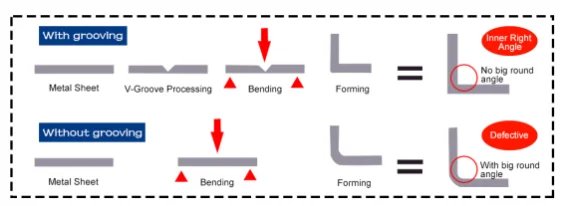
When you bend stainless steel without a V-groove, the uncut thickness forces a large bend radius that spoils the sharp, premium look of decorative trims. Our V-grooving function pre-slots a precise “V” line at each bend, cutting the effective thickness in half. That means sharp corners instead of rounded blobs, and no unsightly creases on the decorative surfaces. Industry experts explain it best: V-grooving produces “a very small radius on the outside of the bend and no radius at all on the inside,” yielding clean, tight joints that are perfect for close-fitting panels.
A grooved stainless panel ready for bending: V-grooving gives the crisp corners on decorative parts. In practical terms, V-grooving halves the metal at the bend point, so the outside corner nearly closes up. You avoid the large, round corner that would otherwise appear with plain bending. Decorative parts (hotel or kitchen trims, for example) demand that sleek, solid look, and with this grooving-before-bending approach, you get it every time.
(1).png)